You don't know exactly what a species is. And Neither do I.
The Species Problem
No one definition has satisfied all naturalists; yet every naturalist knows vaguely what he means when he speaks of a species. - Charles Darwin
What is a species? A nice, easy question. At around age 12 in school, the definition is given: it’s a living thing where all the members of the group are similar to each other but different from everything else. There may be different-looking dogs, but they are all clearly not cats.
At 15, it is refined to explain that species or subspecies are defined by whether the creature can interbreed and produce fertile offspring. One of my final year undergraduate classes started with this same question… What is a species? By the end of the class, we did not have a strong conclusive answer.
This is less a flaw of the academics who work on such issues than just an inconvenient reality of working in the natural world. Our complex globe does not like to play by neat categories. Often referred to as “The Species Problem”, the more we’ve gone on to discover more about the world, Darwin’s observation on the vagueness of a species has only got truer.
Hybrid Species
The traditional reproduction-based measure of species is at first jeopardised by all those that reproduce asexually. You may know already, a Mule is a hybrid between a horse and a donkey. Mules aren’t a species because they aren’t able to reproduce, but there are countless documented cases, especially in plants, of hybrids at first being infertile but then developing into fully recognised species.
Drawing the line at when a hybrid is and isn’t a species is extremely messy. In the UK, the amount of goose hybridisation makes the whole thing an amalgamation of species and not species that’s hard to decipher. In the UK alone, the identification site iNaturalist reports a massive 46 duck and goose hybrids present.
If all these species of duck and goose are able to make ducklings together, it leads to questions as to whether they are really different species. However, just looking at them, by the Darwin “everyone vaguely knows what a species is” definition… These guys look totally different; they have to be different species.
In the case of these ducks, I’m going to tentatively suggest it doesn’t matter. It will cause a headache for people looking to identify the ducks, and it won’t be easily obvious if the hybrid offspring become fertile or not. After all, if a duck is the child of two other hybrid ducks, we wouldn’t have any clear way to prove it. But ultimately, the ancestry of that duck is not of major concern to anyone.
This isn’t always the case however, this is not always the case. I have shared below a graph from a research report linked in the description. This demonstrates the hybridisation of two snakes in Wisconsin, USA. In the overlapping habitat region, the ancestry of each snake is difficult to discern. This mattered because at the time of the study, Butler’s gartersnake on the left was a protected and endangered species in Wisconsin, but the plains gartersnake on the right was common and under no protection. Somewhere in this contact zone, it becomes illegal to interfere with the snakes, but I certainly wouldn’t want to be the one deciding where.
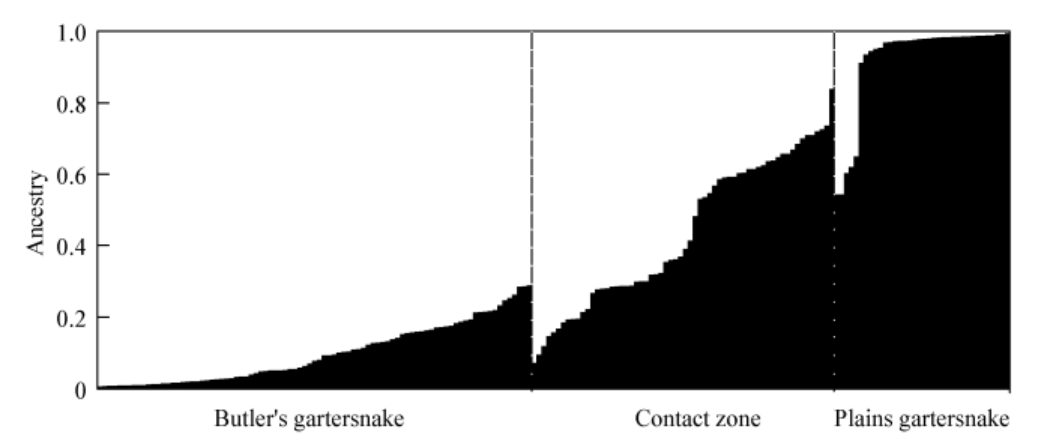
From Fitzpatrick et al. 2015 - A study of genetic mixing between an endangered and common pair of gartersnake species.
This matters for more than just legal reasons, too; hybridisation can pose a serious risk to species like this population of butler’s gartersnake. If the other species is more prolific, this genetic curve may slowly shift across, and by ignoring this, the protected population could disappear without anyone realising that it’s only hybrids left.
I don’t have a satisfying answer to how we deal with hybrids to conclude this section. Modern attempts to tackle the problem seem to be mostly done on a local case-by-case basis, with conservationists determining whether hybrids present should be protected too, or instead pose a danger to the original population.
Ring Species
This section is a much less practical or applied issue for ecologists. In fact, there’s some genuine dispute about whether any true ring species exist and meet the definition, but this does provide a major thought problem that undermines the logic the species definition is based on.
Hopefully, if you’re still reading this far in, you’ll be aware that variation in groups exists that aren’t different species. You can get very different-looking dogs that are still dogs, or humans that are still humans.
Let’s imagine a bird in region A that lives in a pine forest. It eats the pine nuts and has a tough beak to break into them. The same bird also lives in this forest B, where seeds and grains are more accessible, and has developed a different beak accordingly. It is different but can happily interbreed and produce fertile offspring. Same species, different beaks.
In region C, the same food is available, but the bird gains an advantage by being able to camouflage in long grass and has evolved to have more yellow-green feathers. It is different to our region B bird but can happily interbreed and produce fertile offspring. Same species, different feathers.
In region D, it snows a little and finds more luck eating insects. The bird here has developed a winter coat of mottled white, as well as the yellow-green feathers, and has a pointier beak for insect catching. Our region D bird still regularly mixes and interbreeds with the region C bird; they are definitely both the same species.
Now here comes the problem. If we catch a region D bird and take it to region A. It’s too different, and they won’t mate. Our mottled green and white bird does not recognise the original as its own kind. Perhaps they build nests differently. Have different mating calls; there are all manner of ways to socially or physically deny interbreeding.
So that’s nice and clear then. The Region D bird is definitely a different species from the Region A bird! Let’s label them species 1 and species 2. Except now what are we meant to do with our B and C birds… If we first put B in the species group with A, since we said they are definitely the same bird, the region C bird must then be species 1 because it’s the same species as B… but also must be species 2 because it’s the same species as the region D bird.
This paradox is the crux of the ring species problem. It’s referred to as a ring, not like the line I’ve laid out here, because all the suggested real-life versions of this happening have involved it looping round and Region D having a contact zone with Region A. For example, these 4 habitats could be in a big ring around an impassable mountain or a massive lake. Any sort of barrier that keeps all the groups from intermingling and sharing their DNA too much.
As a former maths student, there’s something I absolutely love about this ring species definition, regardless of whether they exist; there’s some sort of fundamental element to this that is exceptionally hard to unpick with almost any attempt to define a species. It’s probably the purest logic-based disproof of the way we view species compared to what can occur.
Gene Transfer
We’ve seen how ducks, snakes, birds and other macroscopic species can ruin our definition making. Now we turn our hand to the microscopic, because things are just as messy when we zoom in. Microbiologists have split gene transfer into horizontal and vertical (HGT and VGT). I couldn’t tell you why those two words were chosen, but Vertical / VGT is the one you probably think of when someone says genetics.
Vertical is the standard parent giving Genes to their offspring through the reproduction process. Vertical is “both your parents have the blue eye genes, so you do too. Horizontal, on the other hand, is the lesser mentioned, more confusing form of Gene Transfer that is bundled under the rug and hidden away for most of your education. I won’t go into too much detail on how it occurs, the importance to our Species Problem is that it does.
The HGT process allows for snippets of DNA to be shared between species. It’s the main way that resistance to antibiotics or other medicines is spread between bacteria. The spread can be both rapid and interspecies.
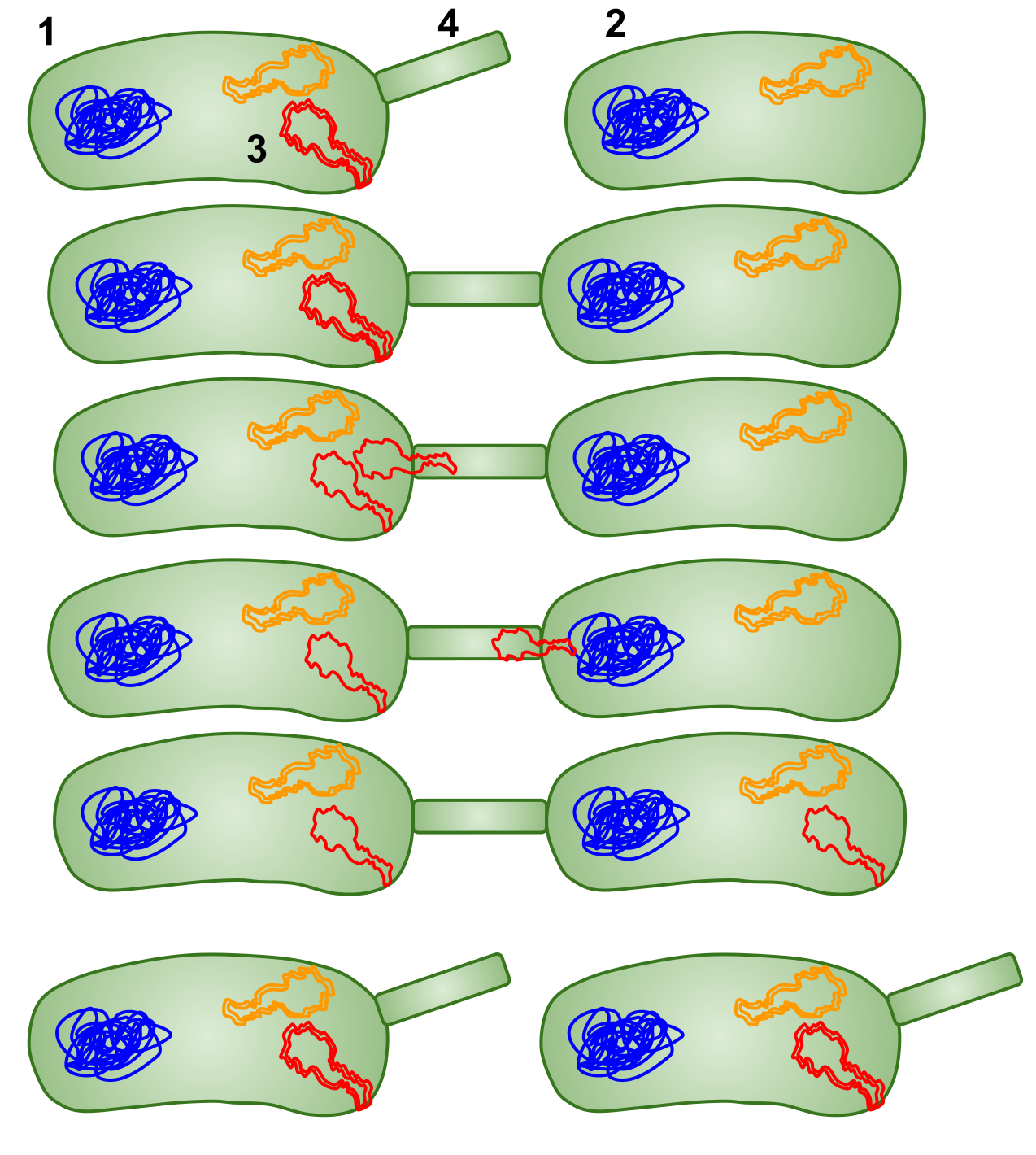
This image from Wikipedia depicts one of the mechanisms by which horizontal gene transfer occurs. Here, a plasmid (in red) is duplicated and moved into a different cell via a physical connection.
This causes issues for the definition of a species because genetics is the backbone of how we’ve defined what a species is. Genes are the indisputable final decider for something’s species if the other methods aren’t sufficient. But… What percentage of difference can you allow for something to still be the same species? We encounter a sort of microbial “Ship of Theseus” problem. How many gene transfers can you allow before something is a new species? Since reproduction is asexual through multiplication, you can’t just put two bacteria together and see if they still mate.
In practice, microbiologists and pathologists talk about “Strains”, which allows them to focus on splitting a species up into different genetic versions with different traits, without stopping to have theoretical debates about whether the new strain is or isn’t a new species. Sometimes strains get later reclassified as their own species, but really this is of relatively little concern to the microbiologist focused on diseases, symbiotic processes or other bacterial interactions.
While this admittedly, like the Ring Species, does not pose a strong practical issue to daily science, it demonstrates that genetic testing fails to provide a definitive rebuke to the other issues, as what a species’ genes can or cannot include is also not so clear-cut.
If species is such a messy word, why bother?
At this point, I may have convinced you that it’s all made up, and we get rid of it, and I’m sorry about that. It’s necessary that to end off I must make a defence of the word. Again, referring back to the Darwin Quote. We all roughly know what one is when we see it, which is a really helpful asset for talking about science or climate change. When people talk about species going extinct, it doesn’t matter if it’s a genetic mess as to where the species boundary is; the point of what is being lost gets conveyed neatly to everyone.
Understanding that it isn’t simple and knowing all these ways that the definition is flawed is necessary for those working in conservation or genetic ecology. As highlighted in the hybrids section, these problems can be real practical issues when protecting areas, species and habitats. Therefore, the word species works, but only if those who work in the field of ecology understand that it comes with an asterisk. In truth, 99% of people can escape their whole lives without really needing to know that species isn’t a simple word, but if you’re one of that 99% and you’ve made it this far:
You can now join the group of people who use the word as normal, knowing there’s a silent asterisk on the end of their sentences.